Blog
Understanding Quality, Manufacturing Standards, and Research Applications

Good Manufacturing Practice (GMP peptides) and Pharmaceutical Grade Peptides
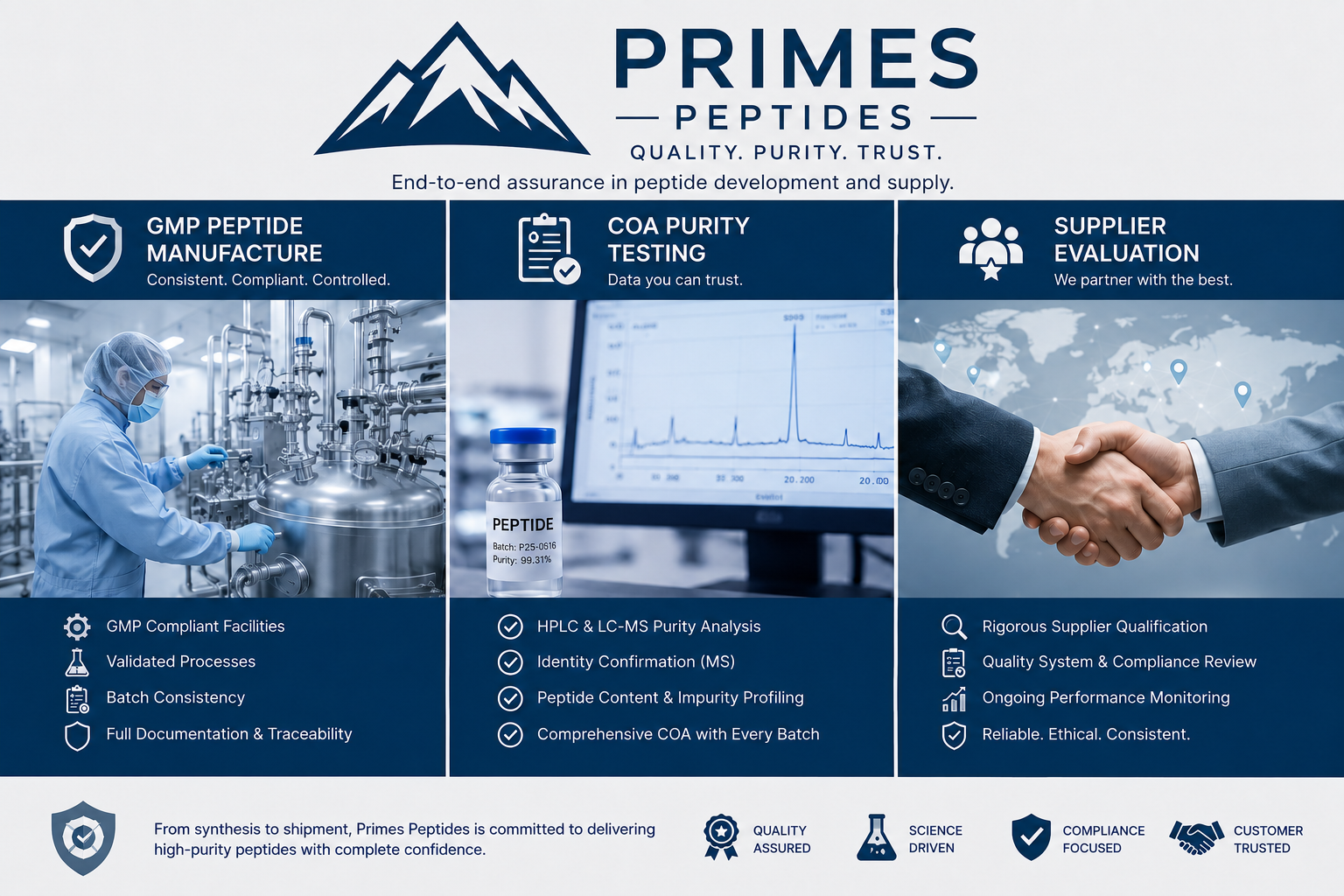
GMP peptides One of the defining characteristics of pharmaceutical grade peptides is their association with Good Manufacturing Practice (GMP) principles. GMP refers to a comprehensive quality system that governs how pharmaceutical products are manufactured, tested, packaged, stored, and distributed. Rather than focusing solely on the final product, GMP emphasizes consistency throughout the entire production process.
A GMP-compliant manufacturing environment is designed to minimize contamination, reduce production errors, and ensure that every batch is produced according to predetermined quality standards. These systems are particularly important for peptide manufacturing because peptides are highly complex biological molecules that require precise synthesis and handling.
Manufacturers operating under GMP principles typically implement strict controls over every stage of production, including:
- Qualified manufacturing equipment
- Controlled cleanroom environments
- Standard operating procedures (SOPs)
- Personnel training and competency assessments
- Environmental monitoring
- Equipment calibration and maintenance
- Batch record documentation
- Change control procedures
- Quality assurance audits
These systems work together to improve manufacturing consistency while supporting product quality and traceability.
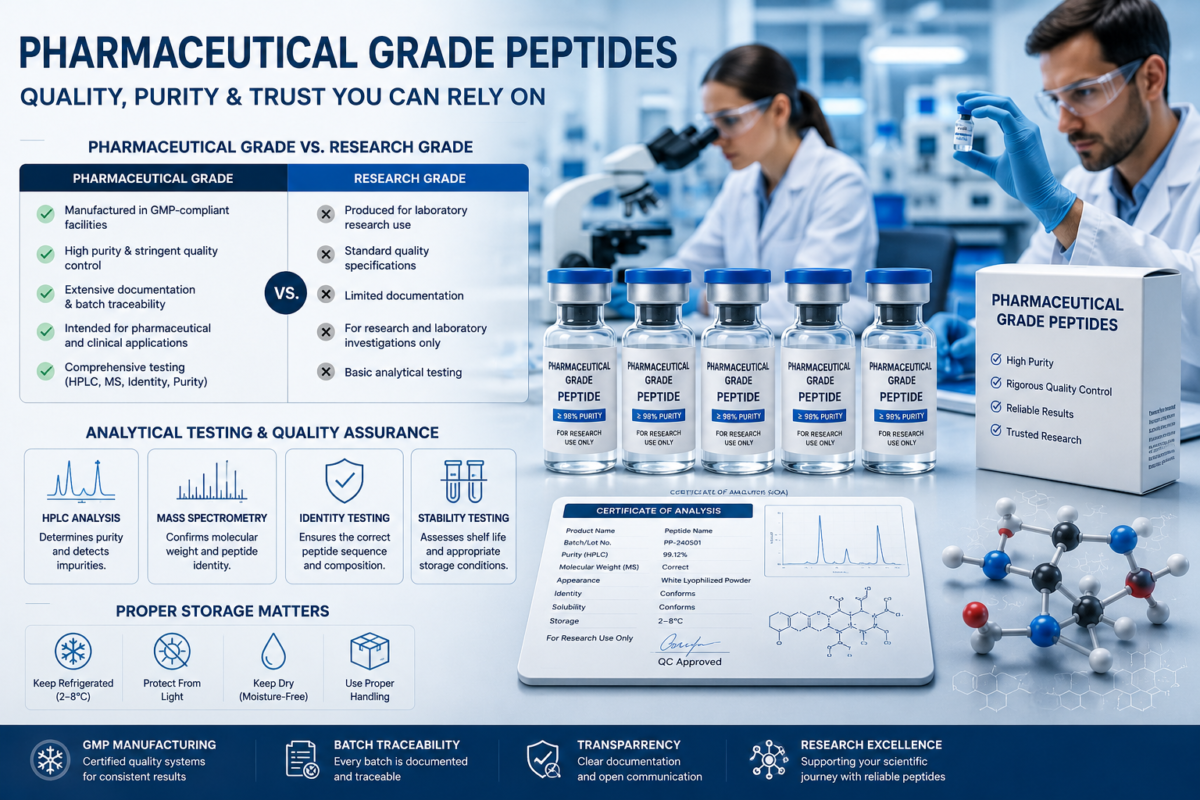
Pharmaceutical Grade vs. Research Grade Peptides
One of the most frequently asked questions in peptide science concerns the distinction between pharmaceutical grade peptides and research-grade peptides. Although both may contain identical amino acid sequences, they differ significantly in manufacturing controls, intended purpose, documentation, and regulatory oversight.
GMP Peptides Manufacturing Standards
Pharmaceutical-grade peptides are manufactured using highly controlled processes designed to meet stringent pharmaceutical quality requirements. Every production step is validated, documented, and monitored to ensure consistency between batches.
Research-grade peptides, on the other hand, are generally manufactured for laboratory investigations. While reputable suppliers often produce high-quality research peptides, these materials may not be manufactured under the same comprehensive pharmaceutical quality systems.
Quality Documentation
Pharmaceutical-grade products typically include extensive documentation supporting manufacturing quality, including:
- Batch production records
- Raw material traceability
- Analytical testing reports
- Stability data
- Validation records
- Quality assurance reviews
Research-grade products may provide Certificates of Analysis and laboratory testing data, but documentation requirements are generally less extensive than those associated with pharmaceutical manufacturing.
Intended Use
Perhaps the most important distinction lies in intended use.
Pharmaceutical-grade peptides are manufactured for applications that require compliance with pharmaceutical manufacturing standards.
Research-grade peptides are generally intended for scientific investigation and laboratory research rather than clinical use.
Understanding this distinction helps researchers select products that align with their intended scientific applications and regulatory requirements.
Why Peptide Purity Matters
Purity is one of the most discussed characteristics of peptide quality, yet many researchers misunderstand what purity percentages actually represent.
When manufacturers report a peptide purity of 98% or 99%, they are generally referring to the proportion of the desired peptide relative to detectable impurities under specific analytical testing methods.
Higher purity provides several advantages during scientific investigation.
Improved Experimental Consistency
Impurities can introduce unwanted variables into laboratory experiments.
When researchers work with highly purified peptides, they reduce the likelihood that unidentified contaminants will influence experimental outcomes.
This improves:
- Experimental reproducibility
- Data interpretation
- Biological consistency
- Laboratory reliability
Reduced Chemical Impurities
Sophisticated purification techniques help remove:
- Truncated peptide sequences
- Incomplete synthesis products
- Oxidized molecules
- Organic reaction by-products
- Residual synthesis reagents
Removing these impurities contributes to overall manufacturing quality and product consistency.
Greater Batch-to-Batch Reliability
Consistent purity specifications help ensure that different production batches perform similarly during laboratory evaluation.
This consistency is especially important for long-term research projects where multiple peptide batches may be used over several months or years.
Understanding the Certificate of Analysis (COA)
A Certificate of Analysis (COA) is one of the most valuable quality documents accompanying pharmaceutical-grade peptide products. It provides detailed analytical information verifying that a specific production batch meets established quality specifications.
Researchers frequently review COAs before selecting peptide products because these documents offer transparency regarding manufacturing quality.
A typical Certificate of Analysis may include:
- Product name
- Batch or lot number
- Manufacturing date
- Purity results
- Molecular weight confirmation
- Appearance description
- Storage recommendations
- Analytical testing methods
- Identity verification
- Quality control approval
The COA serves as an important quality assurance document by allowing researchers to verify that analytical testing has been performed on the specific batch they receive.
Analytical Testing Used for Pharmaceutical Grade Peptides
Analytical science plays a central role in peptide quality assurance. Modern laboratories employ sophisticated instrumentation capable of verifying identity, purity, and molecular characteristics with remarkable precision.
High-Performance Liquid Chromatography (HPLC)
HPLC remains one of the most widely used analytical methods for peptide evaluation.
During HPLC testing, peptide molecules travel through specialized chromatographic columns that separate compounds according to their chemical properties.
This produces chromatograms that allow scientists to evaluate:
- Purity
- Impurity profile
- Batch consistency
- Manufacturing performance
HPLC has become an industry standard because of its exceptional sensitivity and reproducibility.
Mass Spectrometry (MS)
Mass spectrometry confirms that the synthesized peptide possesses the expected molecular weight.
This technique provides highly accurate molecular identification while helping verify that the desired amino acid sequence has been successfully synthesized.
When combined with HPLC, mass spectrometry offers powerful confirmation of peptide identity.
Identity Testing
Identity testing ensures that the manufactured product matches the intended peptide sequence.
Depending on manufacturing protocols, identity confirmation may involve multiple complementary analytical techniques.
Verifying identity is critical because even a single amino acid difference may significantly alter peptide characteristics.
Stability Studies
Manufacturers also perform stability testing to determine how peptide quality changes over time under various storage conditions.
Stability studies help establish:
- Recommended storage temperatures
- Shelf-life estimates
- Packaging requirements
- Transportation guidelines
These studies contribute to maintaining product integrity throughout distribution and storage.
Storage and Stability of Pharmaceutical Grade Peptides
Even the highest-quality peptide can lose integrity if stored improperly. Appropriate storage conditions help preserve molecular stability while reducing degradation over time.
Several environmental factors influence peptide stability.
Temperature
Temperature control is one of the most important considerations.
Manufacturers often recommend refrigerated or frozen storage depending on the specific peptide formulation and intended storage duration.
Avoiding repeated freeze-thaw cycles may help preserve product integrity.
Moisture Protection
Many peptide products are supplied in lyophilized (freeze-dried) form because removing water improves long-term stability.
Exposure to excessive humidity can accelerate degradation, making moisture-resistant packaging an important aspect of quality preservation.
Light Protection
Certain peptide compounds may be sensitive to prolonged exposure to ultraviolet or direct sunlight.
Manufacturers frequently use amber vials or protective packaging to minimize light exposure during storage.
Proper Handling
Careful laboratory handling also contributes to maintaining peptide quality.
Researchers typically follow documented handling procedures designed to minimize contamination while preserving product consistency throughout experimental use.
How to Evaluate a Pharmaceutical Peptide Supplier
Selecting a reputable peptide supplier requires evaluating more than advertised purity percentages. A reliable supplier should demonstrate transparency regarding manufacturing quality, testing procedures, and documentation.
When assessing a supplier, consider the following factors:
Comprehensive Certificates of Analysis
Reputable suppliers should provide batch-specific analytical documentation rather than generic quality statements.
Independent Laboratory Testing
Third-party analytical verification can provide additional confidence in reported quality specifications.
Transparent Manufacturing Information
Quality-focused suppliers often explain their manufacturing processes, testing procedures, and quality management systems in detail.
Consistent Batch Documentation
Reliable documentation helps ensure traceability while supporting long-term research reproducibility.
Secure Packaging and Shipping
Appropriate packaging protects peptide integrity during transportation by minimizing environmental exposure and physical damage.
Common Misconceptions About Pharmaceutical Grade Peptides
As peptide research has grown, several misconceptions have become widespread.
One common misunderstanding is that a higher purity percentage alone automatically makes a peptide pharmaceutical grade. In reality, pharmaceutical-grade quality depends on the entire manufacturing system, including validated processes, quality management, documentation, and comprehensive analytical testing not just purity alone.
Another misconception is that all peptides labeled “pharmaceutical grade” meet identical standards worldwide. Regulatory expectations and manufacturing practices can vary across jurisdictions, making it important to evaluate suppliers based on transparent quality documentation rather than marketing terminology.
Finally, some assume that pharmaceutical-grade and research-grade peptides are interchangeable. While the peptide sequence itself may be identical, differences in manufacturing controls, intended use, documentation, and quality assurance distinguish these categories.
shop at : https://primespeptides.com/
One thought on “Understanding Quality, Manufacturing Standards, and Research Applications”