

Blog
Legal risks for patients buying research peptides


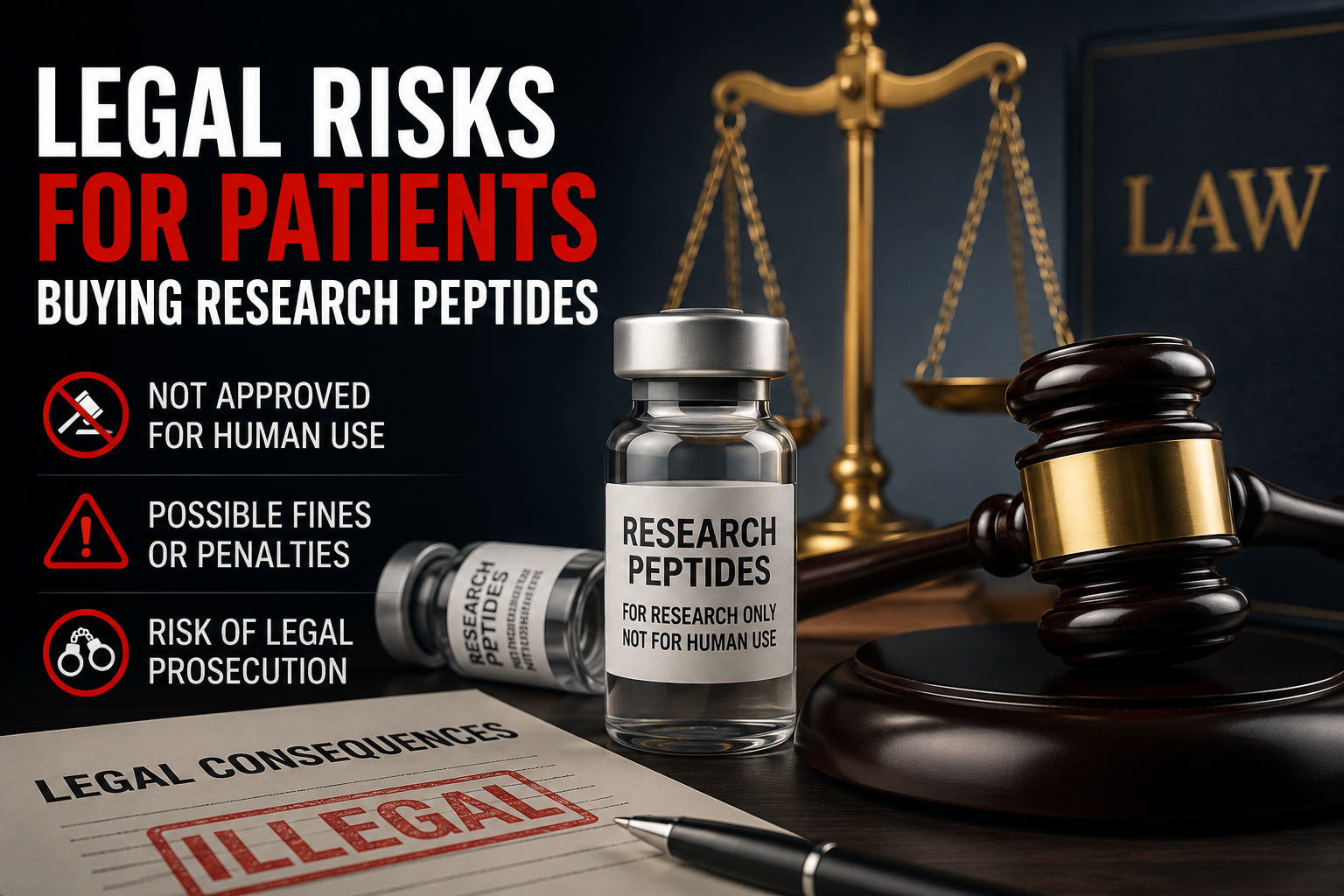 Legal risks for patients buying research peptides, They face a different set of risks. The legal exposure is generally lower than for physicians, but health risks may be higher.
Research peptides have become increasingly visible across scientific publications, online communities, and laboratory research. Interest continues growing as researchers investigate compounds linked to metabolism, tissue repair, hormone signaling, and other biological processes.
Despite rising awareness, confusion still surrounds the legal status of research peptides. Many buyers assume every peptide product follows the same regulations as approved prescription medications. Others believe every product offered online qualifies for personal use. Neither assumption reflects current regulatory practices.
Understanding the legal risks for patients buying research peptides begins with understanding one important distinction. Research peptides and approved pharmaceutical products belong to different regulatory categories.
Prime Peptides believes informed buyers make better decisions. Education supports responsible purchasing while helping customers understand applicable laws before ordering research products.
Personal use enforcement
The good news for individuals is that the FDA primarily focuses enforcement on sellers, not buyers. Personal possession of research peptides for self-administration rarely results in criminal prosecution.
However, “rarely” doesn’t mean “never.” The FDA can and does pursue enforcement when circumstances warrant. And state laws may differ from federal enforcement priorities, creating additional risk depending on your location.
The bigger concern is that purchasing unapproved drugs removes you from the legal healthcare system. You can’t sue a Chinese peptide manufacturer if their product harms you. You have no legal recourse if you receive contaminated or mislabeled products. You’re operating entirely outside the protective framework that pharmaceutical regulation is designed to provide.
Legal risks for patients buying research peptides: Quality and safety risks
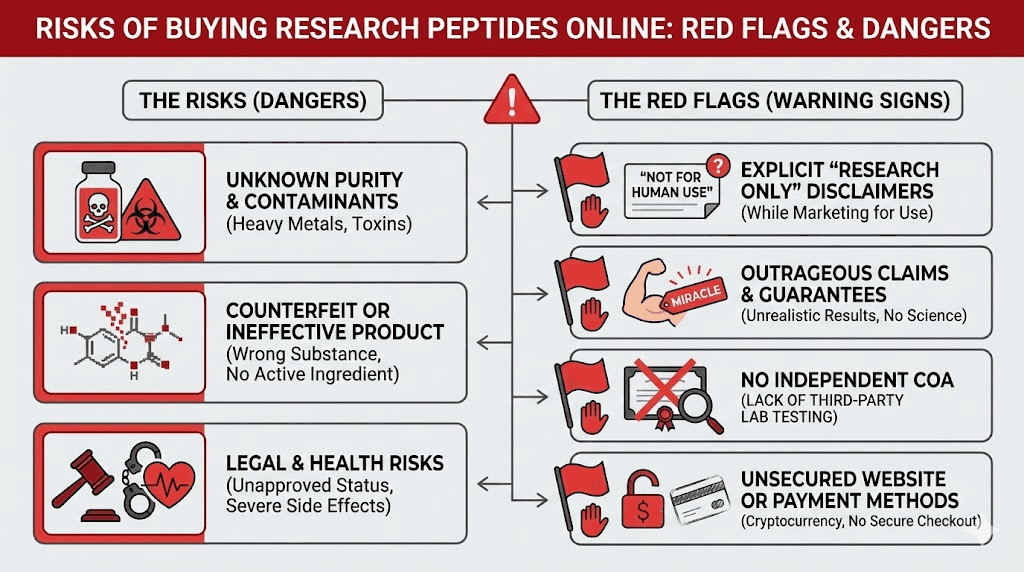
Research-grade peptides don’t come with the quality guarantees of pharmaceutical products. You’re trusting unknown manufacturers to produce sterile, pure, accurately-dosed products without any regulatory oversight ensuring they do so.
A UC Davis cellular biologist put it bluntly: “Research-grade peptides are going to have junk in them. They’re going to have chemicals used in the purification process and fragments of peptides that you don’t want.”
The rise of cheap peptides from overseas suppliers, some offering products for as little as $5 per vial, has only increased these concerns. Price points that low suggest corners are being cut somewhere in the manufacturing process.
The stability of research peptides during shipping and storage is another concern. Peptides degrade at room temperature, and international shipping rarely includes proper cold chain management. By the time that bargain peptide arrives, it may have lost significant potency or degraded into unknown compounds.
SeekPeptides provides comprehensive guidance on evaluating peptide quality, understanding storage requirements, and recognizing red flags in peptide sourcing. Members access detailed vendor evaluation frameworks and community knowledge from researchers who’ve navigated these challenges.
The “research use only” fiction
The peptide community has developed elaborate linguistic rituals to maintain the fiction that everyone is conducting legitimate research. Forums instruct members to say they’re “researching” peptides rather than “taking” them. Vendors use “research purposes only” disclaimers as legal shields.
This isn’t fooling the FDA. In warning letters, the agency has explicitly stated that despite “research use only” labels, evidence shows products are intended for human use, particularly when sold with syringes, diluents, and dosing instructions for subcutaneous injection.
Enforcement actions increasingly target this gap between stated purpose and actual use. The Department of Justice has prosecuted illegal peptide sellers, and the FDA continues issuing warning letters to companies making therapeutic claims or packaging products in ways that suggest human administration.
What peptides can doctors legally prescribe?
Despite the restrictions on research peptides, doctors have legitimate options for prescribing peptide therapy. Understanding what’s available legally helps patients work with their physicians effectively.
FDA-approved peptide medications
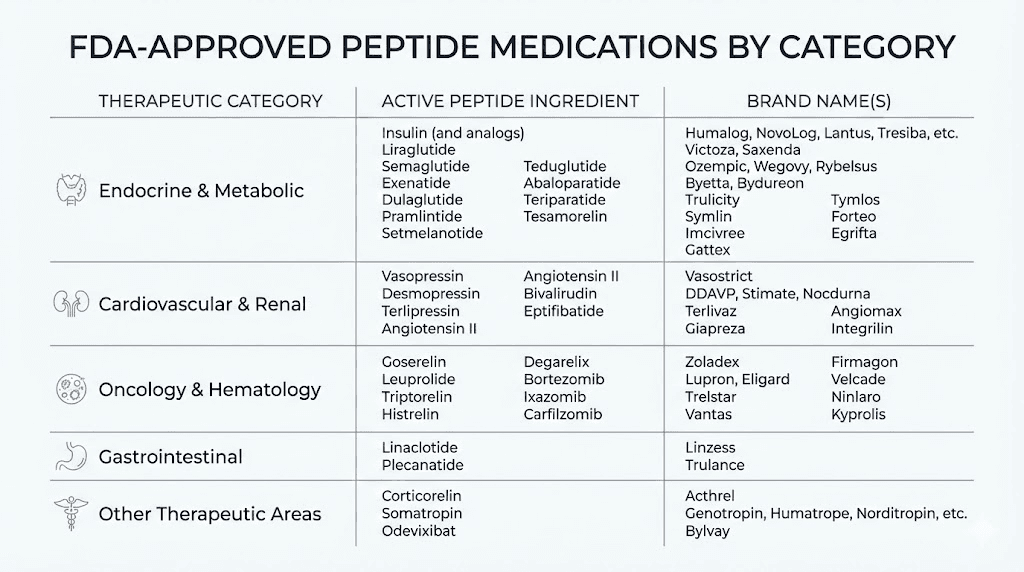
Numerous peptides have full FDA approval and can be prescribed like any other medication.
GLP-1 receptor agonists represent the most high-profile category. Semaglutide treats type 2 diabetes (Ozempic) and obesity (Wegovy). Tirzepatide offers similar benefits through a dual-action mechanism (Mounjaro, Zepbound). Liraglutide (Victoza, Saxenda) was the first in this class to achieve widespread use. These are legitimate, FDA-approved peptides that doctors prescribe millions of times each year.
Insulin is perhaps the most famous peptide medication, essential for diabetes management. Various formulations, from rapid-acting to long-acting, are available by prescription.
Oxytocin is FDA-approved for labor induction and certain postpartum applications. It’s administered in hospital settings under medical supervision.
Bremelanotide (Vyleesi) is an FDA-approved peptide for hypoactive sexual desire disorder in premenopausal women. It demonstrates that even peptides affecting sexual function can achieve legitimate approval.
Teriparatide (Forteo) is an approved peptide for osteoporosis treatment, showing that bone-related peptide therapies can be legally prescribed.
Compoundable peptides
Beyond FDA-approved drugs, certain peptides can be legally compounded under the 503A framework. These require a physician’s prescription for an individual patient.
Sermorelin can be compounded for growth hormone optimization. It stimulates the pituitary gland to produce more natural growth hormone, unlike synthetic HGH which replaces the body’s production. Physicians prescribe it for growth hormone deficiency and sometimes off-label for anti-aging purposes.
Gonadorelin is available through compounding for fertility and hormone therapy applications. It acts on the hypothalamic-pituitary-gonadal axis to influence reproductive hormone production.
GHK-Cu can be compounded for topical use only. The FDA specifically prohibited injectable administration, but topical applications for skin rejuvenation remain legal through compounding pharmacies.
PT-141 (Bremelanotide) exists both as an FDA-approved drug and as a compoundable substance, though the regulatory status can vary. Physicians sometimes prescribe compounded versions for sexual health applications.
Off-label prescribing of approved peptides
Physicians have significant latitude to prescribe approved peptides for unapproved uses. This is called off-label prescribing, and it’s completely legal when the drug itself has FDA approval.
For example, a doctor might prescribe semaglutide for weight loss even if the patient doesn’t meet the strict criteria for the FDA-approved obesity indication. They might prescribe low-dose naltrexone, a peptide-like compound, for inflammation even though it’s only approved for opioid addiction. These are legitimate medical decisions within the physician’s professional judgment.
The key distinction: the drug must be FDA-approved for something. Off-label prescribing expands the uses of approved drugs. It doesn’t make unapproved drugs legal.
How to access peptide therapy legally
For patients interested in peptide therapy, legal pathways exist. They require working within the healthcare system rather than around it.
Finding a qualified physician
The first step is finding a doctor experienced with peptide therapy. Not every physician is comfortable prescribing these medications or knowledgeable about optimal protocols.
Specialists who commonly work with peptides include endocrinologists for hormone-related therapies, obesity medicine specialists for weight loss peptides, anti-aging and longevity medicine practitioners, sports medicine physicians for performance and recovery applications, and integrative medicine doctors who take a comprehensive approach to health optimization.
When searching for a provider, look for board certification in relevant specialties, experience specifically with peptide medications, willingness to discuss treatment goals and options, and use of legitimate compounding pharmacies when appropriate.
Peptide therapy clinics have proliferated in recent years. Some are excellent, staffed by knowledgeable physicians using legal protocols. Others operate in gray areas, prescribing substances they shouldn’t or sourcing from questionable suppliers. Do your research before committing to any clinic.
SeekPeptides offers resources to help members evaluate providers, treatment options, and make informed decisions about their peptide therapy journey.
One thought on “Legal risks for patients buying research peptides”