


Blog
The legal reality: doctors cannot prescribe research peptides


Legal Pathways for Peptide Prescriptions
Doctors cannot legally prescribe research-grade peptides for human use. This isn’t a gray area. It isn’t a technicality. It’s a fundamental principle of medical regulation in the United States.
Physicians can only prescribe FDA-approved medications or compounds that can be legally prepared by compounding pharmacies. Research peptides fall into neither category. They are not FDA-approved drugs. They cannot be legally compounded because they’re either explicitly banned (Category 2) or not on the approved list for compounding.
The “research use only” label on these products isn’t a loophole. It’s a statement of their legal status. They can be sold for legitimate research purposes, laboratory experiments, scientific studies. They cannot be sold for human consumption, regardless of who’s doing the prescribing.
Why the distinction matters legally
Some people argue that if a doctor prescribes something, that makes it legal. This is incorrect.
Physicians have broad prescribing authority within the scope of legal medications.
They can prescribe FDA-approved drugs off-label, meaning for conditions other than their officially approved uses. This is legal and common practice. Semaglutide prescribed for weight loss when it was only approved for diabetes was off-label prescribing, and perfectly legal because semaglutide itself was an approved drug.
Research peptides are different. They’re not approved drugs being prescribed off-label. They’re unapproved substances that have never gone through the FDA approval process. Prescribing them isn’t off-label use; it’s prescribing an unapproved drug, which violates FDA regulations regardless of the physician’s intentions.
What about compounding pharmacies?
The compounding pharmacy angle confuses many people. They assume that if a compounding pharmacy will make something, it must be legal.
Legitimate compounding pharmacies operating under 503A or 503B frameworks can only compound substances that meet specific criteria. The substance must be the active ingredient in an FDA-approved drug, have a USP monograph, appear on the FDA’s approved bulks list (Category 1), or have GRAS (Generally Recognized as Safe) status.
Most research peptides meet none of these criteria. BPC-157 and TB-500 are not active ingredients in approved drugs. They don’t have USP monographs. They’re not on the Category 1 list. They’re explicitly on the Category 2 list of substances that cannot be compounded.
If a pharmacy is compounding these peptides, they’re operating illegally. Several have faced enforcement actions, including criminal prosecution. The Department of Justice prosecuted Tailor Made Compounding LLC for distributing unapproved peptides including BPC-157, resulting in a $1.79 million forfeiture.
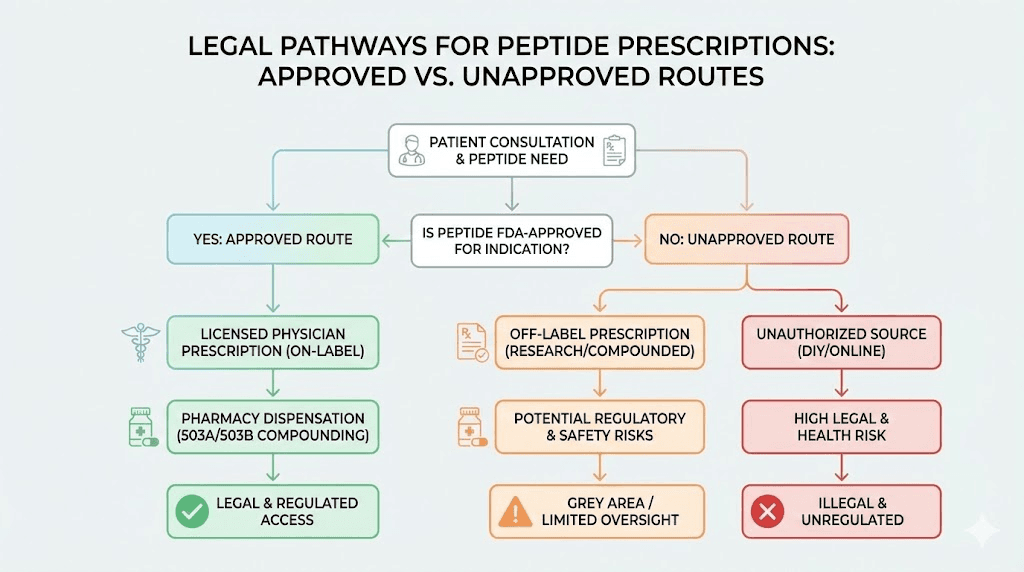
Legal Pathways for Peptide Prescriptions: Approved vs. Unapproved Routes
The infographic titled “Legal Pathways for Peptide Prescriptions: Approved vs. Unapproved Routes” is designed to provide a simple yet comprehensive overview of the different ways patients may obtain peptide therapies and the legal, medical, and regulatory implications associated with each pathway.
Rather than focusing on specific peptide medications, the diagram illustrates the decision-making process that begins with a patient seeking treatment and then branches into three possible routes: an approved prescription pathway, an off-label prescription pathway, and an unauthorized or unapproved pathway.
Through its structured flowchart, color coding, icons, and concise text, the image emphasizes that not all routes to obtaining peptides carry the same level of legal protection, medical oversight, or regulatory compliance.
At the very top of the diagram is the title, “Legal Pathways for Peptide Prescriptions: Approved vs. Unapproved Routes.” This heading immediately establishes the educational purpose of the illustration. It signals that the infographic is intended to help readers understand how peptide therapies fit within existing healthcare and regulatory systems rather than encouraging or discouraging the use of any specific product.
The wording also introduces the central comparison between routes that operate within established medical and legal frameworks and those that fall outside recognized regulatory oversight.
Directly beneath the title is the starting point of the flowchart: “Patient Consultation & Peptide Need.” This box serves as the foundation of the entire diagram because it reinforces that every legitimate healthcare journey begins with a patient seeking medical advice.
Rather than beginning with the purchase of a product or an online order, the process starts with a consultation. This design choice highlights one of the core principles of modern medicine that healthcare decisions should begin with an assessment of an individual’s symptoms, medical history, treatment goals, and overall health status. The inclusion of the patient consultation stage also emphasizes the importance of communication between patients and qualified healthcare professionals before any treatment decisions are made.
Following the consultation stage, the diagram moves to the central decision box labeled “Is Peptide FDA-Approved for Indication?” This is arguably the most important point in the flowchart because it determines which of the three legal pathways follows.
The wording of this box specifically references whether the peptide has been approved for the particular medical condition, or “indication,” being treated. This distinction is significant because regulatory approval is granted for specific uses based on clinical evidence demonstrating safety and effectiveness.
Even if a medication has regulatory approval for one condition, that approval does not automatically extend to every possible medical application. By centering the decision-making process around approved indications, the infographic introduces readers to the concept that medical regulation depends not only on the medication itself but also on how it is intended to be used.
From this central decision point, the diagram branches into three distinct pathways, each represented by a different color. The use of green, orange, and red immediately communicates varying levels of regulatory certainty and risk. Green universally symbolizes safety, approval, and compliance.
Orange represents caution or situations requiring additional consideration. Red indicates high risk, lack of authorization, or potential legal concerns. This intuitive color coding allows viewers to quickly understand the relative status of each pathway before reading the accompanying text.
The first branch, highlighted in green, is labeled “Yes: Approved Route.” This pathway represents the traditional and most straightforward method of receiving peptide therapy within established healthcare systems. It indicates that the peptide has regulatory approval for the medical condition being treated.
The next box beneath it states “Licensed Physician Prescription (On-Label).” The phrase “on-label” refers to the use of a medication exactly as it has been approved by regulatory authorities. This means that the prescribing physician is recommending the peptide for a use supported by the official approval process. The emphasis on a licensed physician reinforces that approved medications are prescribed by qualified healthcare professionals who evaluate whether the treatment is appropriate for the individual patient’s medical circumstances.
The green pathway continues to the next stage, “Pharmacy Dispensation (503A/503B Compounding).” This element introduces another important concept within pharmaceutical regulation. Medications may be dispensed through traditional pharmacies or, in some cases, through regulated compounding pharmacies operating under recognized legal frameworks.
The inclusion of “503A/503B” references regulatory categories for compounding pharmacies, illustrating that even compounded peptide medications can exist within structured regulatory systems when appropriate legal standards are followed. Rather than suggesting unrestricted access, this box emphasizes that medications should pass through legitimate pharmaceutical channels where quality controls, documentation, and professional oversight are maintained.
The final green box is labeled “Legal & Regulated.” This conclusion summarizes the approved pathway. It communicates that when patients consult healthcare professionals, receive an on-label prescription for an approved indication, and obtain their medication through authorized pharmaceutical providers, the process operates within recognized legal and regulatory boundaries. The accompanying green checkmark icon further reinforces the concepts of legitimacy, compliance, and patient safety.
The second branch, displayed in orange, represents a more nuanced situation. It is labeled “Off-Label Prescription (Research/Compounded).” Unlike the approved pathway, off-label prescribing occurs when a physician prescribes an approved medication for a purpose that has not received formal regulatory approval.
It is important to recognize that off-label prescribing is a well-established aspect of medical practice in many healthcare systems and may be appropriate under certain clinical circumstances when supported by medical judgment and available scientific evidence. The orange color reflects that this pathway is neither entirely prohibited nor equivalent to the approved on-label route. Instead, it occupies a middle ground requiring greater professional discretion and careful patient evaluation.
Beneath the off-label prescription box is another orange box reading “Potential Regulatory & Safety Risks.” This stage acknowledges that off-label use can involve additional considerations compared to approved indications. Because the specific use has not undergone the same regulatory review process for that indication, healthcare providers may need to rely on emerging research, published studies, clinical experience, or professional guidelines when making treatment decisions.
Patients receiving off-label therapies may also require closer monitoring to evaluate effectiveness and identify any unexpected side effects. The wording does not suggest that off-label use is inherently unsafe but rather emphasizes that additional medical judgment and oversight are important.
The orange pathway concludes with the box labeled “Grey Area / Limited Oversight.” This final step accurately reflects the complexity surrounding certain compounded or research-related peptide uses. The phrase “grey area” suggests that regulatory oversight may vary depending on jurisdiction, specific products, and clinical circumstances.
Unlike the clear regulatory framework associated with approved, on-label prescribing, off-label or compounded uses may involve evolving policies, differing professional opinions, or varying legal interpretations. The caution symbol accompanying this box reinforces the need for informed decision-making rather than implying outright illegality.
The third branch, shown in red, is labeled “No: Unapproved Route.” This pathway represents situations where peptides are obtained outside recognized healthcare and regulatory systems. The use of the word “unapproved” immediately distinguishes this route from both approved and off-label medical practice.
Instead of involving physician supervision or regulated pharmaceutical channels, the pathway proceeds to the next red box labeled “Unauthorized Source (DIY/Online).” This element reflects situations in which individuals obtain peptide products through unregulated online vendors or other unauthorized suppliers without appropriate medical oversight. The inclusion of “DIY,” meaning “do it yourself,” highlights the absence of professional healthcare involvement.
The next stage in the red pathway is labeled “High Legal & Health Risk.” This box communicates two distinct categories of concern. First, obtaining medications from unauthorized sources may expose individuals to legal issues depending on applicable regulations within their jurisdiction.
Second, products acquired outside regulated pharmaceutical systems may present health risks because they may not undergo the same manufacturing standards, quality assurance procedures, purity testing, sterility verification, or storage controls expected of regulated pharmaceutical products. Without professional supervision, patients may also lack appropriate dosing guidance, monitoring, or management of potential adverse effects.
The final red box concludes with “Illegal & Unregulated.” This endpoint clearly differentiates unauthorized acquisition from medically supervised pathways. The red “X” icon emphasizes that this route falls outside recognized legal and regulatory frameworks.
The use of both “illegal” and “unregulated” communicates that products obtained through unauthorized channels may not comply with pharmaceutical manufacturing standards, healthcare regulations, or prescription requirements.
In addition to its textual content, the infographic relies heavily on visual organization to enhance understanding. The flowchart structure guides readers naturally from the initial consultation through each possible outcome.
Connecting arrows illustrate how each decision leads logically to the next stage, making the diagram accessible even to readers unfamiliar with peptide regulations. The layout also visually communicates that all three pathways originate from the same initial healthcare question but diverge based on regulatory approval and prescribing practices.
The use of medical-themed icons further strengthens the educational message. Along the left side of the approved pathway, symbols representing healthcare professionals, pharmacies, and regulatory approval reinforce the concepts of professional oversight and structured healthcare delivery.
In contrast, the caution triangle associated with the orange pathway and the red “X” associated with the unauthorized pathway provide immediate visual cues regarding increasing levels of uncertainty and risk.
Another notable aspect of the infographic is its emphasis on healthcare processes rather than specific products. The diagram does not promote any individual peptide or therapeutic claim. Instead, it focuses on the systems through which peptide therapies may be accessed, prescribed, or obtained.
This process-oriented approach makes the infographic broadly applicable to discussions about prescription medications, regulatory compliance, patient safety, and responsible healthcare decision-making.
The educational value of the image also lies in its ability to simplify a complex regulatory topic. Pharmaceutical law, prescription practices, compounding regulations, and off-label prescribing can be difficult subjects for the general public to understand.
By reducing these concepts into three clearly defined pathways supported by intuitive colors and concise language, the infographic makes regulatory distinctions easier to grasp without overwhelming readers with technical terminology.
Ultimately, the infographic conveys a clear overarching message: the safest and most legally established pathway for peptide therapy begins with a patient consultation, proceeds through evaluation by a licensed healthcare professional, and continues with regulated pharmaceutical dispensing when appropriate. It also acknowledges that off-label prescribing exists within medical practice but involves additional regulatory and clinical considerations.
Finally, it warns that obtaining peptide products from unauthorized sources outside the healthcare system carries significantly greater legal uncertainty and potential health risks due to the absence of professional oversight and regulatory safeguards.
Taken together, the flowchart serves as an effective educational tool that promotes informed decision-making, patient safety, regulatory awareness, and the importance of seeking qualified medical guidance when considering peptide therapies.
Its logical structure, balanced presentation, and clear visual hierarchy allow readers to understand the distinctions between approved, off-label, and unauthorized pathways while emphasizing the role of healthcare professionals in ensuring safe and responsible treatment decisions.
Legal risks for physicians prescribing research peptides
Doctors who prescribe or administer unapproved peptides face serious professional and legal consequences. This isn’t theoretical risk; it’s documented reality with case examples.
Medical malpractice exposure
The standard of care in medicine does not include injecting or prescribing unapproved experimental peptides. When a physician deviates from the standard of care and a patient is harmed, that’s malpractice.
With research peptides, the malpractice risk is particularly acute. Some legal experts argue that prescribing unapproved peptides like BPC-157 is malpractice per se, meaning automatic malpractice, because it’s impossible to adequately inform a patient of risks that haven’t been studied in humans.
The informed consent challenge compounds the problem. Informed consent requires explaining known risks. With unapproved peptides, the risks are largely unknown. How can a doctor obtain meaningful informed consent for a substance that hasn’t undergone human safety trials? This gray area makes patient consent legally and ethically murky.
Malpractice insurance issues
Here’s a critical consideration that many doctors don’t realize until it’s too late.
Malpractice insurance policies typically exclude coverage for activities that violate federal law or fall outside the standard of care. Prescribing unapproved peptides potentially triggers both exclusions. If a patient is harmed and sues, the physician’s malpractice insurance may deny the claim entirely.
This leaves the doctor personally liable for legal defense costs and any damages awarded.
Medical malpractice lawsuits can result in judgments of hundreds of thousands or millions of dollars.
Without insurance coverage, a single lawsuit could financially destroy a medical practice.
Medical board discipline
State medical boards regulate physician conduct and can take disciplinary action for unprofessional behavior. Advising patients to use unapproved drugs is generally considered unprofessional conduct that can trigger board investigation and discipline.
Potential consequences include formal reprimand, probation with practice restrictions, mandatory education requirements, fines, and license suspension or revocation. These actions become part of the physician’s permanent record and are publicly searchable, damaging reputation and future employment prospects.
Recent enforcement trends show increased scrutiny. Ohio suspended four medical spa licenses in a single action for improper handling of cosmetic drugs. States are ramping up enforcement against medical and wellness practices that fail to comply with peptide regulations.